
I heard Alexander Embiricos at OpenAI describe their AI product management process:
- 01Develop new capabilities.
- 02Ship them to a small group.
- 03Notice what gets used.
- 04Refine it and bring it to more people.
Start with something open ended. See what people do with it. Turn what works into an opinionated product for a particular business need.
His example was ChatGPT Work: take a subset of Codex’s capabilities and offer it to a broader audience. He cited 25 million users already, with a billion ChatGPT users to reach as that loop continues.
Elk makes that process available to every company that hasn’t built its own.
Elk runs the whole cycle.
Connect your existing systems, including PostHog and Notion, and your agent subscriptions. Put it to work observing your product, identifying opportunities, coordinating improvements, and learning from the results.
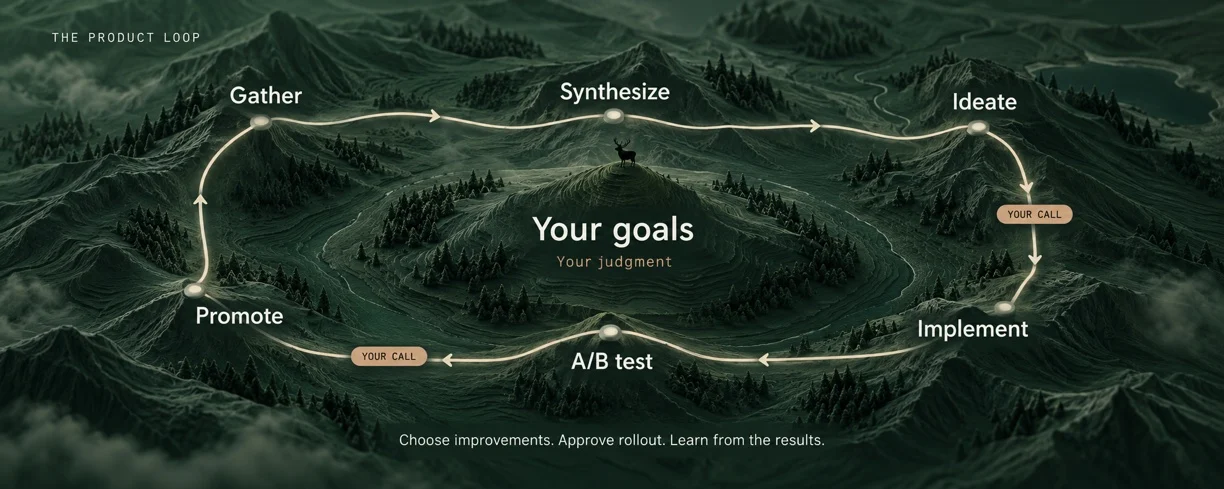
You can start using it immediately. The connections between evidence, decisions, execution, and outcomes are part of the product. You don’t have to engineer an agent workflow around a knowledge graph before it becomes useful.
There’s a technical innovation underneath this that makes the whole thing work.
We call it a Recursive Self-Improving Platform, or RSIP. It is the data pipeline under Elk and the storage it fills.
As your product develops, the information you need changes. You might start by asking what customers use. Then you need to understand why development slowed down, whether reliability is affecting adoption, what changed in the market, or which compliance requirements apply.
Elk iterates its own pipeline and storage to meet those needs:
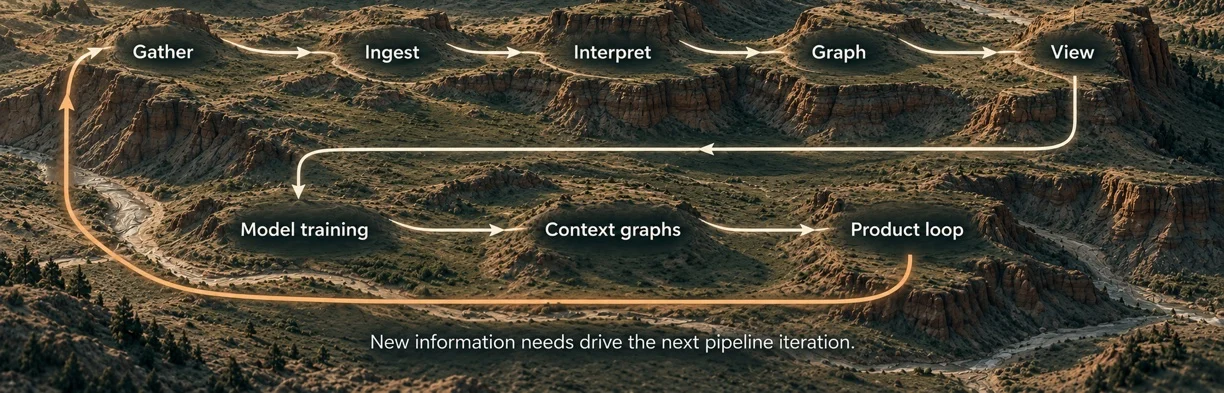
It improves what it collects, how it stores and understands it, and how that understanding becomes available to people and agents. The pipeline feeds a model training loop that curates context graphs, which in turn inform the product management cycle. As that cycle raises new questions, the pipeline evolves again.
Researchers are seeing the same effect. In DataFoundry, agents fix the weak steps of a data pipeline before it runs at scale. Models trained on its data scored higher in math, finance, law and medicine. The same model without the loop did worse. The study also found a limit: after a few rounds, more self-improvement made results worse. That is one reason Elk keeps a person in the loop.
Graph techniques are part of this process, along with many others. Elk’s job is to carry the process through to a better product, then use what happens to improve the next cycle.
That’s the idea behind Elk: give every company a working system for continually discovering what’s useful, building on it, and bringing it to more people.
Yang et al., “DataFoundry: Evolving Data Preparators via Recursive Self-Improvement”, arXiv:2608.29966, 2026.